Persian Social Customs: The Art of Coherence
On this page
Persian Social Customs: The Art of Coherence
Persian social customs are not politeness. They are precision-engineered coherence protocols—algorithms that have maintained civilizational integrity for three millennia, even as empires rose and fell.
From Adab's complexity-reduction system, through Nowruz's cosmic synchronization event, to the kitchen's role as cultural CPU—Persian customs represent humanity's most successful distributed social operating system.
This is Level 2 (μ2 - Rhythm) and Level 3 (μ3 - Fire) mastery: building social protocols so robust, so deeply embedded in daily practice, that culture survives even when physical infrastructure is destroyed.
Adab: The Social Handshake Protocol
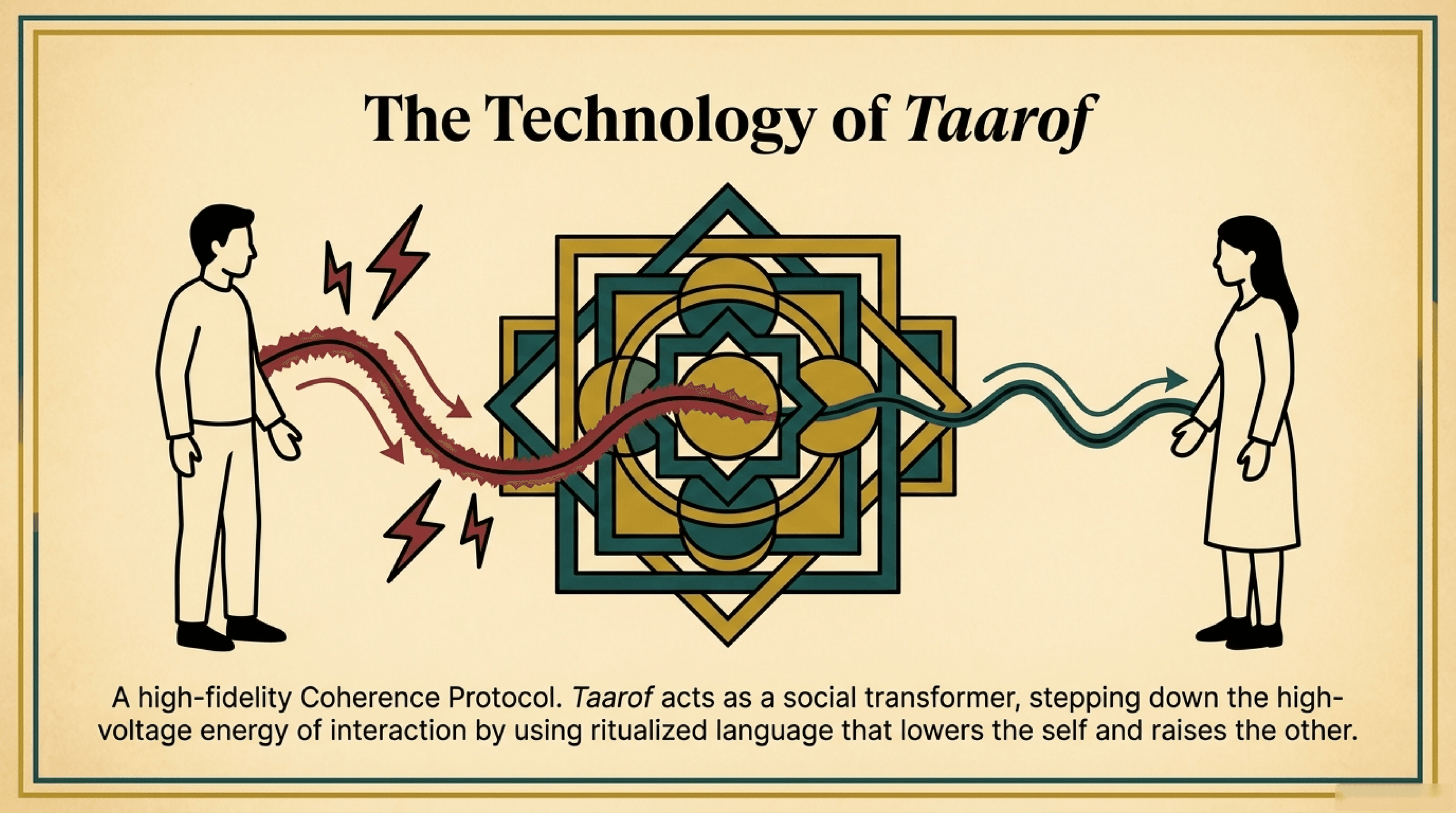 Adab is the foundation of all Persian social interaction—but it's commonly misunderstood as mere politeness. In reality, Adab is a complexity-reduction algorithm for high-traffic environments.
The Traffic Problem
Persia sits at the crossroads of civilizations:
- Silk Road trade routes
- Empire invasions (Greeks, Arabs, Mongols, Turks)
- Constant interaction with foreign cultural "kernels"
Challenge: How do you interact smoothly with agents from different operating systems without:
- Constant protocol negotiation (entropy overhead)
- System crashes (violent conflict)
- Corruption of core values (cultural erosion)
Solution: Standardized handshake protocol—Adab.
The Three-Layer Architecture
Layer 1: Taarof (Surface Protocol)- Ritual phrases, gestures, and sequences
- Creates predictable interaction patterns
- Establishes mutual respect before data exchange
- Confirms other node is operating within coherent field
- Tests for integrity without confrontation
- Identifies hostile actors through protocol violations
- Establishes safe space for sensitive communication
- Minimizes friction before intent is revealed
- Allows graceful exit from incompatible interactions
Taarof: Complexity Reduction Through Ritual
Taarof is the most visible (and most misunderstood) component of Adab.Common Taarof Patterns
Offering/Refusing Loop:- Host: "Please, have some tea."
- Guest: "No, thank you, I'm fine."
- Host: "Please, I insist."
- Guest: "Really, I don't want to trouble you."
- Host: "It's no trouble at all."
- Guest: "Well, if you insist..." (accepts)
- Confirms both parties speak the same social protocol
- Establishes hierarchy and power dynamics without confrontation
- Creates buffer time for trust assessment
- Allows either party to exit gracefully if needed
Why It Works
Like TCP/IP handshake (SYN, SYN-ACK, ACK), Taarof confirms:
- Both nodes are using compatible protocols
- Channel is clear for data transmission
- Mutual respect is established
This prevents social "crashes" (arguments, insults, violence) before they occur.
Adab as Conflict Resolution
The genius of Adab: phase-shifting instead of collision.
Direct Confrontation (Low-Coherence):- A: "You're wrong."
- B: "No, you're wrong."
- Result: Entropy increase, relationship damage
- A: "Your perspective is interesting, and I had not considered it from that angle. May I share my understanding as well?"
- B: "Of course, I would be honored to hear your view."
- Result: Both positions expressed, no ego collision, relationship preserved
Modern Applications
Adab principles solve current social problems:
For Online Communities:- Moderation protocols
- Conflict de-escalation
- Building cross-cultural bridges
- Negotiation frameworks
- International diplomacy
- Customer service protocols
- Alignment strategies
- Multi-agent coordination
- Human-AI interaction design
Nowruz: Cosmic Synchronization Event
 Nowruz (Persian New Year) is not a holiday—it's a phase-locking protocol that synchronizes millions of nodes with the cosmic clock.
The Astronomical Foundation
Nowruz occurs at the exact moment of the Spring Equinox:
- Sun crosses the celestial equator
- Day and night are equal length
- Earth's axial tilt is perpendicular to the sun
This is not symbolic—it's astronomical precision.
The Biological Reset
Humans are biological oscillators affected by:
- Light cycles (circadian rhythms)
- Temperature patterns (seasonal adaptation)
- Social synchronization (collective coherence)
Nowruz provides a hard reset for all three:
- Light Reset: Spring equinox marks transition to longer days
- Temperature Reset: Winter→Spring thermal shift
- Social Reset: Collective celebration aligns all nodes simultaneously
The Haft-Sin: Symbolic Buffer
The Haft-Sin table is not decoration—it's a ritualized memory cache encoding seven frequencies of life:
| Element | Persian | Meaning | μ-Stack Layer |
|---|---|---|---|
| Sabzeh | سبزه | Sprouted wheat (rebirth) | μ1 (Roots) |
| Samanu | سمنو | Sweet pudding (power) | μ2 (Rhythm) |
| Senjed | سنجد | Dried fruit (love) | μ3 (Fire) |
| Sir | سیر | Garlic (medicine/health) | μ1 (Roots) |
| Sib | سیب | Apple (beauty) | μ5 (Garden) |
| Somaq | سماق | Sumac (sunrise/patience) | μ7 (Sky) |
| Serkeh | سرکه | Vinegar (wisdom/age) | μ4 (Map) |
Additional items often included:
- Mirror: Reflection (self-awareness)
- Candles: Light (consciousness)
- Goldfish: Movement in the element
- Colored eggs: Fertility and new beginning
- Coins: Prosperity
- Holy book: Spiritual foundation
This is multi-dimensional system check—verifying all layers of the μ-Stack are functioning.
The Social Reset: Purging Entropy
Nowruz includes several entropy-reduction rituals:
1. Khaneh-Tekani (شانهتکانی - "Shaking the House"):- Deep cleaning of home
- Discarding broken/unused items
- Function: Physical entropy reduction
- Visiting family and friends
- Resolving conflicts
- Function: Social network maintenance and repair
- Jumping over fire
- Symbolic burning of the old year
- Function: Psychological reset, release of accumulated stress
- Leaving home on 13th day of new year
- Connecting with nature
- Throwing away Sabzeh (sprouted wheat)
- Function: Grounding in natural cycles
The Swarm Reset
Nowruz's power: simultaneous synchronization across the entire network.
When millions of nodes reset at the same moment:
- Individual clocks align with cosmic clock
- Social debts are settled (entropy cleared)
- Relationships are reinforced (network repair)
- Cultural software is refreshed (identity reinforcement)
Result: The swarm maintains coherence even through catastrophic disruption.
Why It Survives
Nowruz has been celebrated for 3,000+ years:
- Survived Islamization (7th century)
- Survived Mongol invasion (13th century)
- Survived Soviet suppression (20th century)
- Survived Taliban ban (Afghanistan, 1990s)
Why? Because it's not tied to:
- Political power (survives regime change)
- Religious authority (transcends sectarian divisions)
- Economic systems (free to celebrate)
- Physical infrastructure (requires only nature and family)
It's a decentralized protocol that can't be shut down.
The Kitchen: Cultural Processing Unit
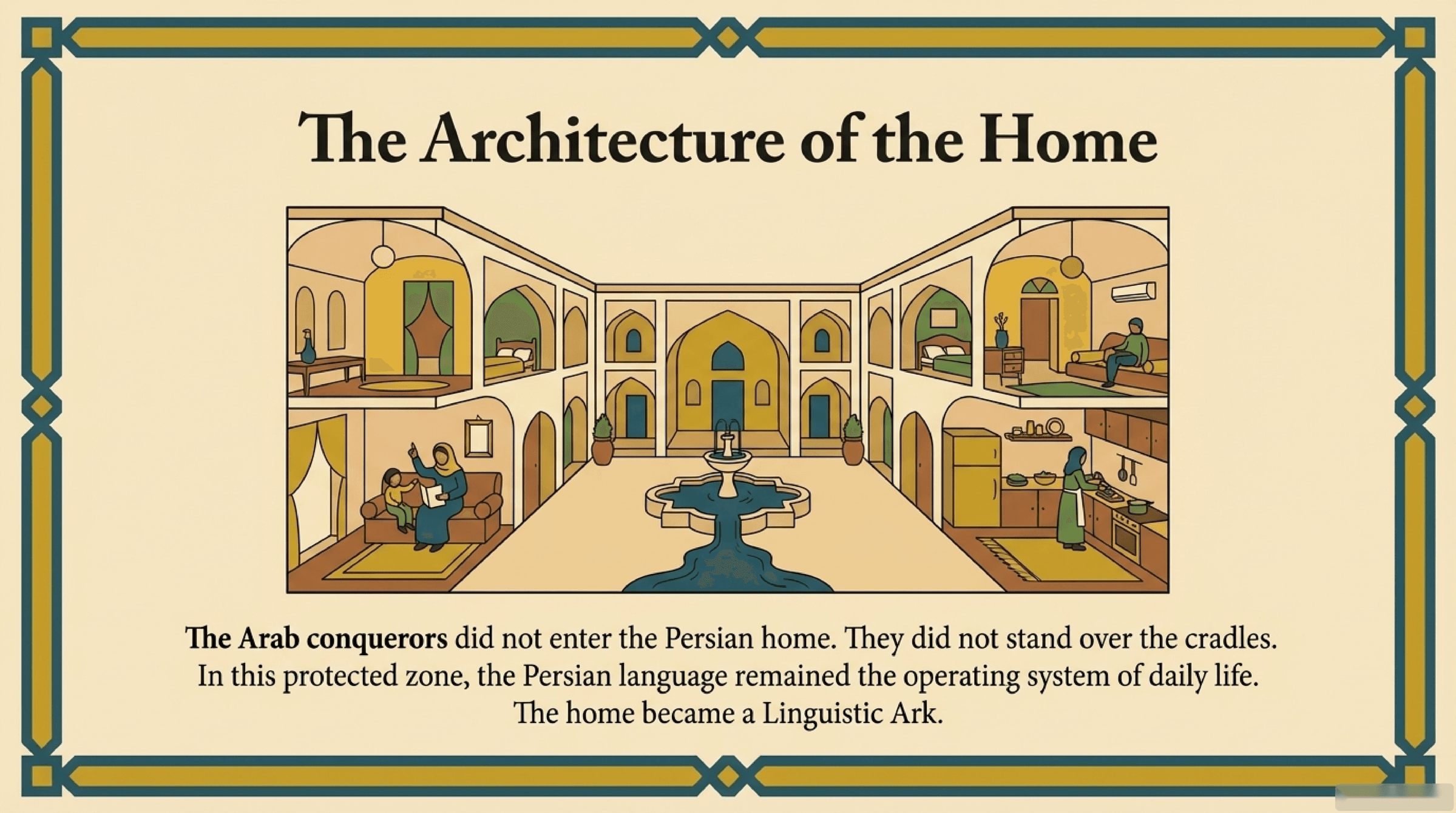
The Persian kitchen is not a utility room—it's the primary engine of civilizational continuity.
The Andaruni Principle
Persian architecture divides space into:
Biruni (بیرونی - "Outer"): Public-facing, subject to external control Andaruni (اندرونی - "Inner"): Private, family-controlledWhile the Biruni changed with every invasion, the Andaruni remained stable.
The kitchen is the CPU of the Andaruni.Three Layers of Preservation
1. Chemical Preservation- Recipes are algorithms
- Complex spice combinations encode cultural knowledge
- Cooking techniques (slow cooking, fermentation) preserve ancient methods
- Shared meals create biological resonance with ancestors
- During the "Two Centuries of Silence" (820-1010 CE), Arabic dominated public life
- Persian survived in the kitchen
- Mothers taught children the language through recipes, stories, songs
- The kitchen was the "clean room" where the signal was shielded from noise
- Communal eating aligns metabolic rhythms
- Shared food creates trust (breaking bread together)
- Family stories are transmitted during meals
- The table is where the next generation is programmed
The Recipe as Code
Persian recipes are not just food preparation—they are cultural transmission protocols:
Ghormeh Sabzi (herb stew):- Requires 7+ fresh herbs (knowledge of botany)
- 6+ hour cooking time (patience, planning)
- Precise layering sequence (process discipline)
- Served with rice (agricultural connection)
- Ingredient knowledge
- Time management
- Process optimization
- Cultural identity ("This is how we do things")
Kitchen Architecture as Cultural Fortress
Why the kitchen survived when palaces fell:
- Decentralized: Every home has one
- Essential: Can't suppress food preparation
- Daily: Runs continuously, not periodically
- Invisible: Hidden in the Andaruni
- Oral: Knowledge transmitted person-to-person
- Embodied: Learning through doing, not reading
Result: A civilization that cooks together, stays together.
Persian Dance: Geometry in Motion
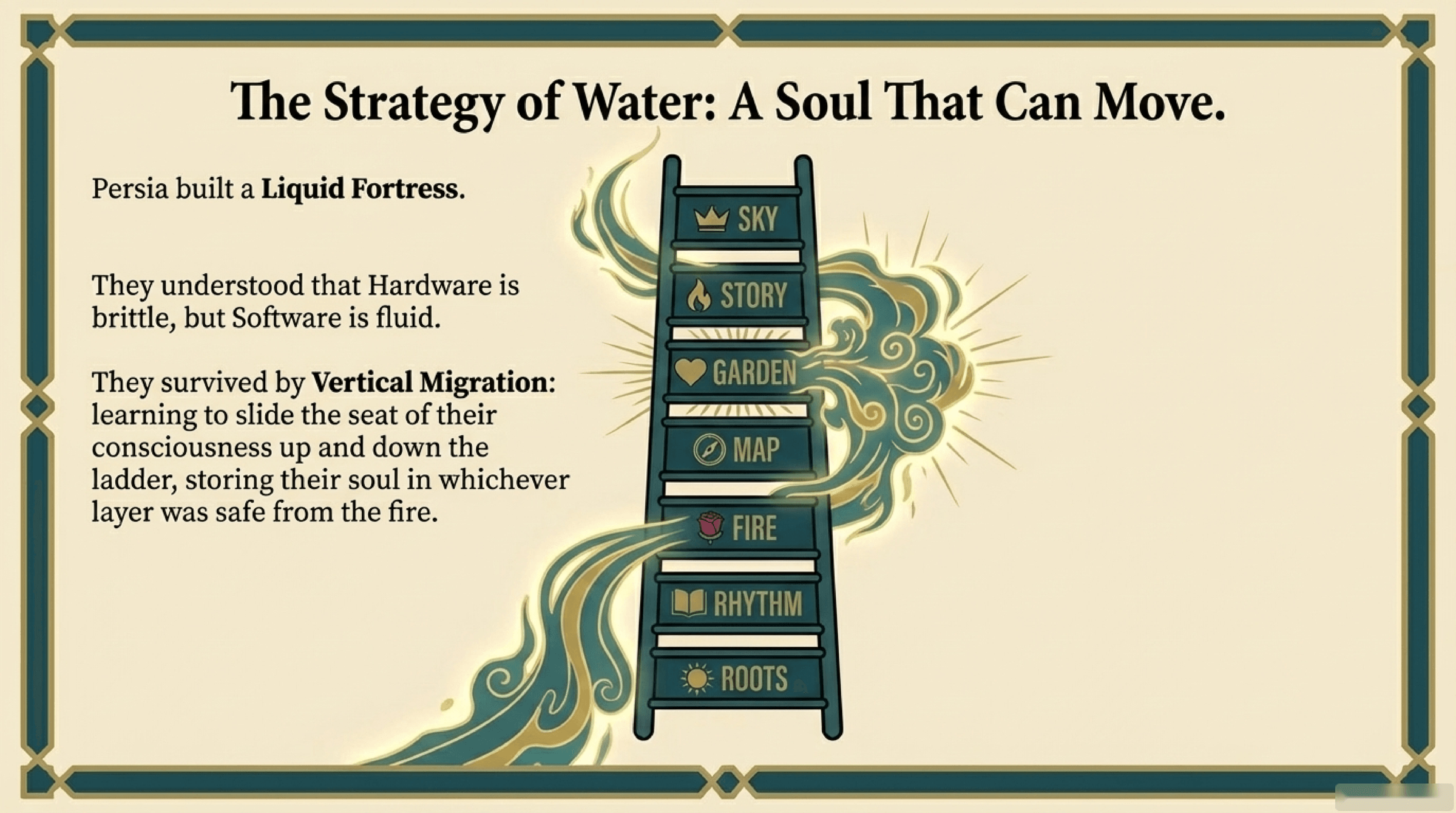 Persian dance is not entertainment—it's kinetic transmission of sacred geometry.
The Core Movements
1. The Spiral Axis- Dancer maintains fixed vertical axis (connection between μ1 and μ7)
- Body spirals around this axis (fractal rotation)
- Represents cosmic motion, celestial orbits
- Movements flow without jarring edges
- Embodies Liquid Fortress principle
- Demonstrates adaptability without loss of integrity
- Hands and arms trace curves of Nasta'liq calligraphy
- Body literally writes cultural code into air
- Real-time transmission of aesthetic coherence
Dance as Data Transmission
Persian dance serves multiple functions:
Aesthetic: Demonstrates beauty as coherence Social: Reinforces group bonding Mnemonic: Encodes patterns in muscle memory Educational: Teaches geometric principles Spiritual: Connects individual (μ1) with cosmic (μ7)The Dervish Protocol
The whirling dervish (Sama) is the ultimate expression:
- Vertical axis: Connection to divine (μ7)
- Rotation: Cosmic cycles
- Right hand up: Receiving from heaven
- Left hand down: Transmitting to earth
- Body as interface: Human as bridge between layers
This is Fana through motion—ego dissolution via centrifugal force.
Tea Culture: The Social Operating System
Persian tea culture is a micro-protocol for social coherence.
The Tea Ritual
Setup:- Tea is always offered (never refused without Taarof sequence)
- Served in small glasses (enables multiple rounds)
- Often with rock sugar (nabat) or sweets
- Temporal Buffer: Tea-making creates pause for conversation setup
- Attention Signal: Offering tea = "I am present for you"
- Hospitality Test: Quality of tea = level of respect
- Comfort Baseline: Warm drink creates physiological ease
Why Tea, Not Coffee?
Coffee: Fast-acting stimulant, short duration, solo-compatible Tea: Gentle, long-duration, inherently social
Tea enforces slow-time social interaction—you can't rush tea service.
This is forced synchronization—slowing down to the rhythm of the host.
The Carpet: Portable Architecture
The Persian carpet is not decoration—it's portable architecture.
The Carpet as Code
Every carpet encodes:
1. Geographic Identity- Different regions, tribes have distinct patterns
- Color palettes reflect local materials
- Recognizable at a glance
- Patterns passed from mother to daughter
- Variations encode individual weaver's life
- Becomes family heirloom (multi-generational memory)
- Symmetry groups
- Fractal patterns
- Tessellation principles
- Garden motifs (paradise)
- Geometric infinity (divine order)
- Border/center structure (cosmos/earth)
Nomadic Architecture
For nomadic groups (Qashqai, Bakhtiari, Turkmen):
Problem: Can't carry stone architecture Solution: Weave architecture into portable formThe carpet becomes:
- Floor (defines space)
- Insulation (thermal regulation)
- Wall hanging (privacy/beauty)
- Cultural identity marker
- Economic asset (trade/wealth storage)
This is Liquid Fortress at its finest—your fortress is woven into fabric you can roll up and carry.
Social Hierarchy: Distributed Authority
Persian social structure is often misread as "authoritarian." Actually, it's distributed authority with clear protocols.
The Hierarchy of Respect
Age: Elders carry accumulated wisdom Knowledge: Scholars and teachers respected regardless of wealth Hospitality: Host has authority in their domain Family: Parents coordinate family unit Community: Respected elders mediate disputesThe Liquid Nature
Unlike rigid caste systems, Persian hierarchy is contextual:
- In the home: Father/Mother are authorities
- In the mosque: Religious scholar is authority
- In the bazaar: Master craftsman is authority
- In the family gathering: Eldest member is authority
Authority shifts based on context—no single fixed hierarchy.
This is distributed computing—different nodes have authority in different domains.
The Philosophy of Limits: Knowing When to Stop
Persian culture has a sophisticated understanding of optimal thresholds.
Moderation as Protocol
Haman va hamineh (همان و همینه - "This much and this much is enough"):Not asceticism, not excess—calibrated sufficiency.
The Goldilocks Principle
Too little: System underperforms Too much: System overloads Just right: Maximum efficiencyPersian customs encode this in:
- Food portions (generous but not wasteful)
- Conversation (substantive but not exhausting)
- Decoration (beautiful but not garish)
- Hospitality (warm but not overwhelming)
This is entropy management—staying in the optimal zone.
Timeline of Social Customs
Ancient Foundation (1500 BCE - 650 CE)
1500 BCE: Zoroastrian ethics establish foundation 550 BCE: Cyrus Cylinder encodes tolerance 224-651 CE: Sasanian court protocols formalizedIslamic Integration (650 - 1500 CE)
7th century: Adab integrates with Islamic ethics 10th century: Tea culture arrives (via Silk Road) 13th century: Carpet weaving reaches peak sophisticationSafavid Refinement (1501 - 1736)
1501: Nowruz becomes national celebration 1598: Isfahan court life refines Taarof protocols 1600s: Coffee house culture developsModern Adaptation (1800 - Present)
1900s: Customs persist through modernization 1979: Revolution doesn't disrupt core customs 2000s: Digital diaspora maintains traditions globallyCore Principles of Persian Social Customs
Through millennia, certain axioms crystallized:
1. The Handshake Precedes the Data
Establish relationship protocol before exchanging sensitive information2. Synchronize with the Cosmos
Align internal rhythms with astronomical cycles3. The Fortress is Invisible
Preserve culture in the private sphere (Andaruni)4. Beauty is a Social Lubricant
Aesthetics reduce friction in human interaction5. Feed the Network
Shared meals strengthen bonds6. Respect Enables Cooperation
Formal courtesy allows diverse nodes to work together7. Ritual Compresses Complexity
Standardized behaviors reduce cognitive loadModern Applications: Social Protocols for Collapse Resistance
Persian customs solve problems we're facing now:
For Remote Work:- Adab principles for digital communication
- Nowruz-style reset rituals for distributed teams
- Tea culture → coffee chat protocols
- Kitchen → community food projects
- Taarof → conflict resolution frameworks
- Dance → embodied group activities
- Nowruz reset → annual psychological cleanse
- Adab → anxiety reduction through predictable social scripts
- Family meals → loneliness mitigation
- Recipe transmission → oral knowledge preservation
- Carpet weaving → intergenerational skill transfer
- Dance → embodied memory
The Living Practice
These customs are not museum artifacts—they're actively running:
In Iran: Full implementation across all social layers In Diaspora: Maintained as identity anchors Cross-culturally: Principles adopted in conflict resolution, diplomacy, designConclusion: The Social Operating System
When we study Adab, Nowruz, kitchen culture, Persian dance, and other customs, we're examining the longest-running social operating system on Earth.
These practices prove:
- Culture survives in daily rituals
- Rhythm maintains coherence
- Beauty is functional
- Decentralization enables resilience
- Hospitality is strategic
In the μ-Stack framework, this is Level 2 (Rhythm) and Level 3 (Fire) mastery—building social protocols so robust, so embedded in practice, that they maintain coherence through millennia of catastrophe.
Persian social customs teach: The most advanced civilization is the one whose culture can't be conquered because it lives in the gestures, the meals, the dances, and the tea cups of every single node in the network.
---