Persian Literature: The Living Tradition
On this page
Persian Literature: The Living Tradition
Persian literature is not entertainment. It is the civilizational hard drive—a distributed storage system that has maintained cultural coherence for over three millennia, surviving invasions, book burnings, and the collapse of empires.
From the Shahnameh's 50,000 lines of archetypal code, through the compressed wisdom of Rumi's ecstatic verse, to the high-resolution visual narratives of miniature painting—Persian literature represents history's most successful cultural preservation protocol.
This is Level 6 (μ6) mastery: encoding identity, ethics, and cosmic truth into infinitely reproducible patterns that can be transmitted orally, visually, and textually across generations.
The Shahnameh: Civilizational Operating System
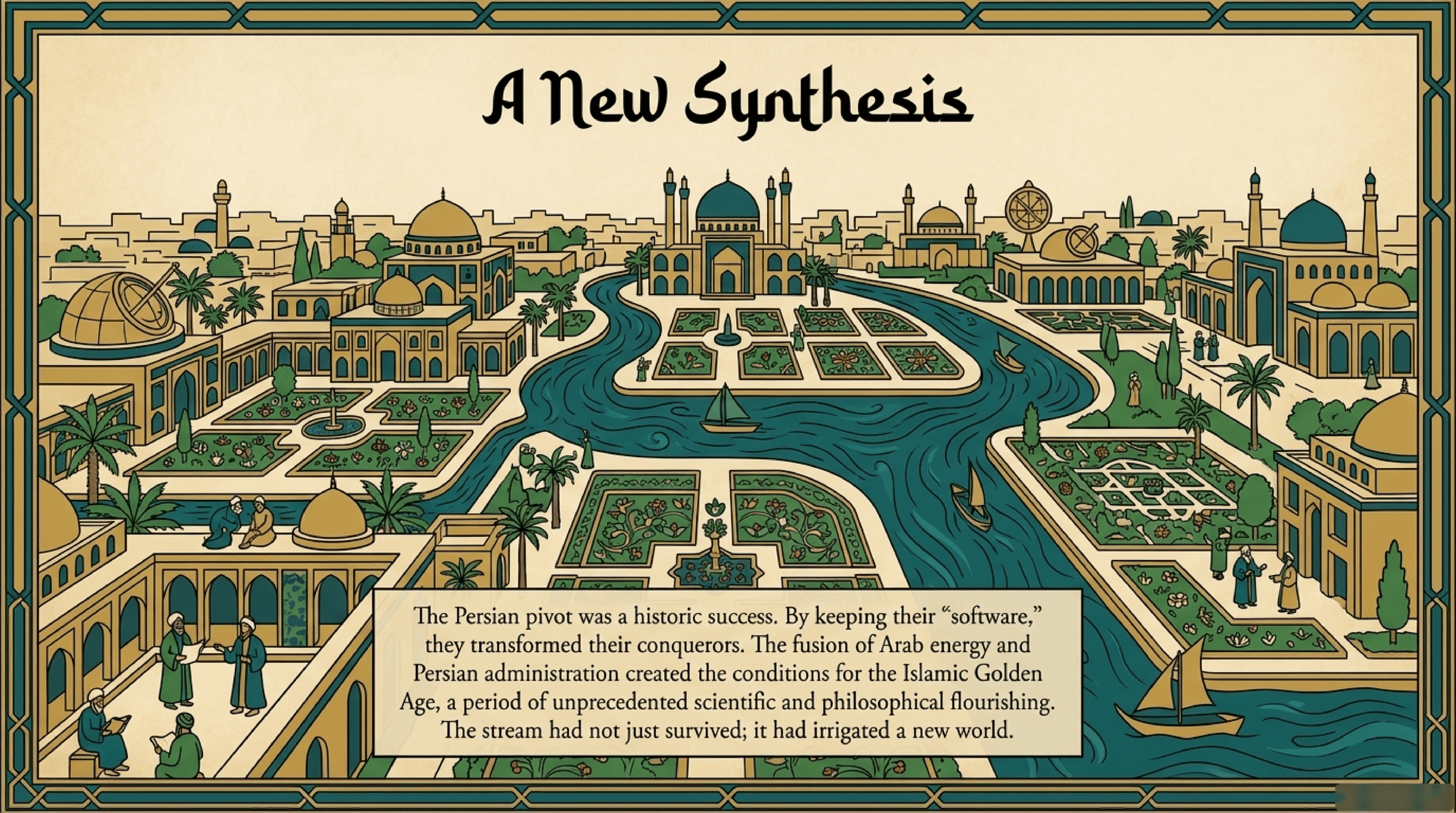
The Shahnameh (Book of Kings) is Ferdowsi's 60,000-couplet masterwork—but to call it poetry misses its true function. It is a 50,000-line operating system for Persian identity.
Written in the Dark
Between 820-1010 CE, Iran experienced the "Two Centuries of Silence"—a period when Arabic dominated, and Persian seemed destined for extinction.
Ferdowsi spent 30 years (977-1010 CE) compiling, refining, and perfecting the Shahnameh. This was not literary ambition—it was software preservation during a civilizational crash.
The Architecture of Memory
The Shahnameh encodes multiple layers simultaneously:
Level 1 (μ1 - Roots): Historical Memory- Chronicles of kings, battles, dynasties
- Geographic knowledge of the Iranian plateau
- Material culture (weapons, architecture, customs)
- Written in mutaqarib meter—perfectly suited for oral recitation
- Rhyming couplets create error-correction through pattern expectation
- Rhythmic structure enables memorization of vast amounts of data
- Constant battle against Druj (The Lie)
- Models of justice, courage, wisdom
- Warning patterns (what causes kingdoms to fall)
- Rostam: The warrior-protector protocol
- Kaveh: The revolutionary blacksmith (popular sovereignty)
- Zal: The outcast who becomes king (marginalized wisdom)
- Sohrab: The tragedy of unknown kinship (consequences of war)
Cross-Platform Portability
The genius of the Shahnameh: it requires no physical hardware.
Unlike libraries (destroyed by invaders), the Shahnameh lives in human memory:
- Oral Transmission: Recited by storytellers (naqqal) in coffeehouses
- Visual Encoding: Illustrated in miniature paintings
- Ritual Performance: Enacted in Naqqali and Ta'zieh theater
- Written Preservation: Copied in illuminated manuscripts
When Baghdad was sacked (1258), libraries burned. But the Shahnameh survived because every node in the network was running the same software.
The 1,000-Year Uptime
The Shahnameh has maintained 100% uptime for over 1,000 years:
- Still memorized by schoolchildren
- Still quoted in daily speech
- Still inspires art, film, literature
- Still defines Persian identity
This is not nostalgia—it's active cultural computation.
The Simurgh: Distributed Intelligence in Narrative Form
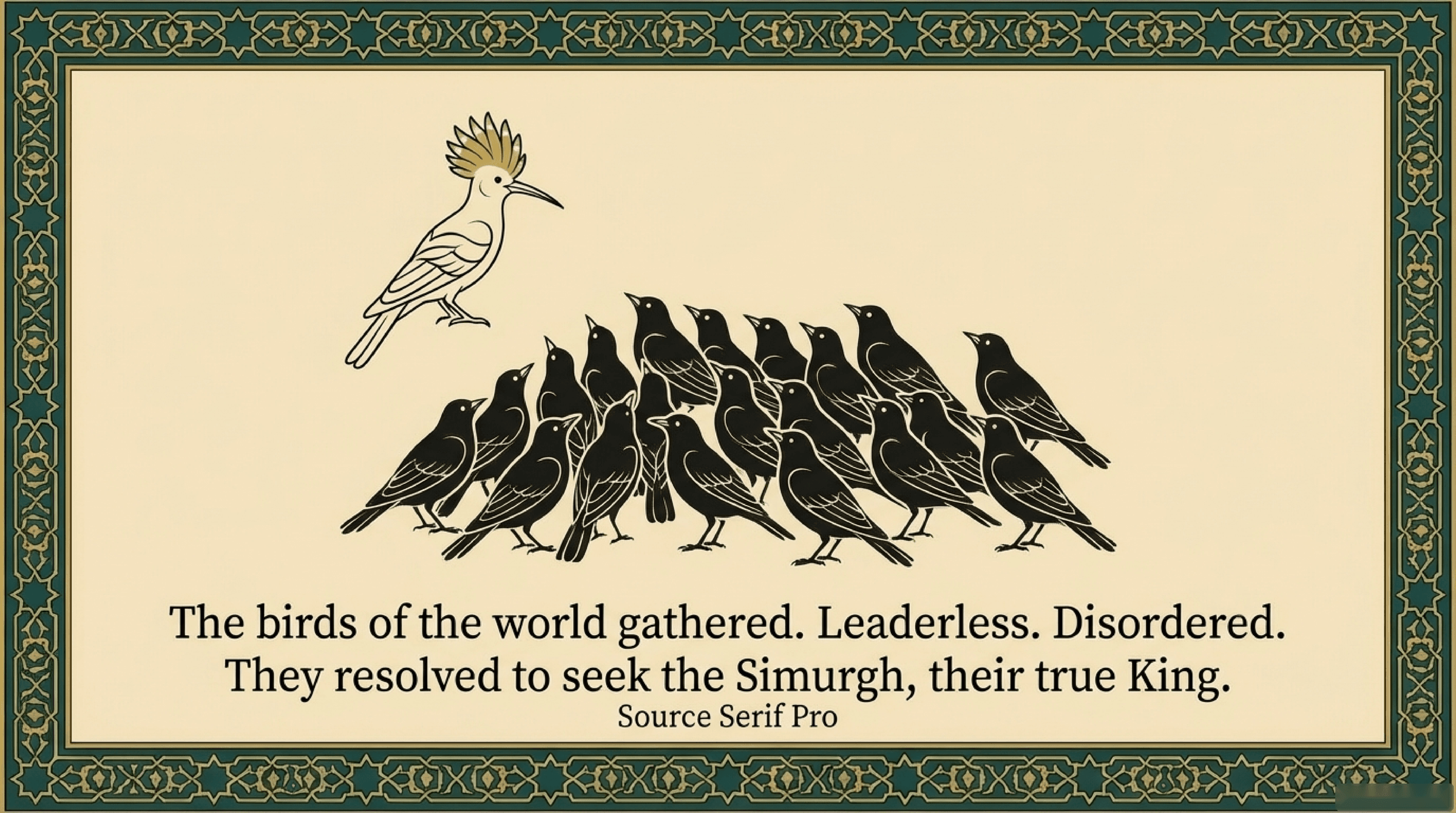
Attar of Nishapur's Conference of the Birds (Mantiq al-Tayr, 1177 CE) is the first manual for swarm intelligence encoded as poetry.
The Narrative Architecture
Setup: Thirty birds seek a king (the mythical Simurgh) Journey: Seven valleys (search spaces) that filter noise Resolution: The birds find only a mirror—they are the SimurghThe Fractal Lesson
In Persian, "Simurgh" = "si" (thirty) + "murgh" (bird)
The revelation: The king they sought was the emergent property of the collective.This is swarm intelligence encoded in 12th-century verse:
- Individual agents (birds)
- Shared goal (finding the king)
- Iterative filtering (seven valleys)
- Phase-locking (alignment through shared hardship)
- Emergence (the collective becomes the entity)
Modern Applications
Today's distributed systems—blockchains, neural networks, collective intelligence platforms—are rediscovering what Attar mapped 850 years ago:
True intelligence is not individual genius; it is coherence across the network.Rumi: Compression Algorithms for Mystical States
Jalal ad-Din Rumi (1207-1273) produced over 70,000 verses in his lifetime—but quantity is not the achievement. The achievement is information density.
The Masnavi: 25,000 Couplets of Pure Signal
The Masnavi-ye Ma'navi (Spiritual Couplets) is known as "the Quran in Persian"—but its power is not religious. Its power is symbolic compression.
Example verse:
"You are not a drop in the ocean.
You are the entire ocean in a drop."
This compresses the entire Unity of Being philosophy (pages of Mulla Sadra's metaphysics) into two lines.
Ecstatic Language as High-Bandwidth Transfer
Rumi discovered that metaphor transmits faster than logic:
- Logical proof: Slow, requires sequential processing
- Poetic image: Instant, bypasses analytical filters
His verses function as direct downloads to the intuitive processor.
The Whirling Dervish: Kinetic Literature
Rumi founded the Mevlevi Order, whose Sama (whirling ceremony) is literature executed through the body:
- The spin represents the cosmos in motion
- The right hand points up (receiving from Sky)
- The left hand points down (transmitting to Earth)
- The dancer is the interface between μ1 and μ7
This is story made physical—a living narrative of cosmic coherence.
Omar Khayyam: Existential Precision

Omar Khayyam (1048-1131) was a polymath—mathematician, astronomer, philosopher. But his Rubaiyat (quatrains) achieved something unique: existential truth in 4-line packets.
The Rubaiyat Structure
Each quatrain is a complete philosophical unit:
- Line 1-2: Setup (observation of reality)
- Line 3: Twist (unexpected insight)
- Line 4: Resolution (cosmic irony or wisdom)
Example:
"The Moving Finger writes; and, having writ,
Moves on: nor all thy Piety nor Wit
Shall lure it back to cancel half a Line,
Nor all thy Tears wash out a Word of it."
This encodes irreversibility (thermodynamics), determinism (physics), and human limitation (metaphysics) in four lines.
Compression vs. Elaboration
Where Ferdowsi elaborates (60,000 couplets), Khayyam compresses (4-line modules).
Both strategies serve the same goal: maximum signal preservation across time.
The Rose and Nightingale: Symbolic Operating System
The most persistent symbol in Persian literature: the Rose and Nightingale (Gol o Bulbul).
The Alchemical Formula
The Rose (Gol):- Silent, perfect, rooted
- Represents the Sky (μ7), the Beloved, absolute truth
- Exists but does not seek
- Singing, searching, suffering
- Represents the Soul, the Lover, human consciousness
- Seeks but cannot possess
The Recursive Loop
The nightingale sings to the rose (which never responds), and this unfulfillable desire becomes the engine of creation:
- Poetry is born from longing
- Art is born from distance
- Meaning is born from the gap between seeker and sought
This is recursive desire—the fundamental algorithm of Persian aesthetics.
Data Compression
A single image of a bird singing to a flower contains:
- Entire volumes of Rumi's poetry
- Sufi philosophy of divine love (ishq)
- The phenomenology of longing
- The mathematics of asymptotic approach (you can get infinitely close but never arrive)
This symbol can be "installed" on any surface: rugs, silver plates, manuscript margins, or spoken verse.
Result: Cultural transmission even when physical infrastructure collapses.Miniature Painting: Visual Literature
Persian miniature painting is not illustration—it is high-density visual narrative.
Non-Euclidean Storytelling
Unlike Western perspective painting (single viewpoint, single moment), Persian miniatures show:
- Multiple timelines: Past, present, future in one frame
- Multiple viewpoints: Inside and outside simultaneously
- Infinite detail: Every surface contains patterns within patterns
- Pure color: No gradients—only high-signal pigments (lapis, gold, vermilion)
Information Architecture
A single miniature encodes:
- Narrative (what's happening)
- Character (facial expressions, postures)
- Setting (architectural details, natural elements)
- Symbolic (colors, objects carry meaning)
- Aesthetic (pure beauty as coherence demonstration)
- Calligraphic (text integrated into visual field)
This is multi-modal compression—story, data, symbol, and beauty unified.
The Interface of the Soul
Miniatures don't depict reality—they create interfaces for resonance.
The viewer doesn't "look at" the image; they enter the Andaruni of the visual field and synchronize with the archetypal patterns within.
Hafez: The Oracle of Shiraz
Hafez (1315-1390) is the most quoted poet in Persian—not for fame, but for functional utility.
The Divan as Operating System
Hafez's Divan (collected poems) serves as:
- Divination Tool: Randomly open to a page for guidance (fal-e Hafez)
- Daily Wisdom: Memorized verses for life situations
- Aesthetic Standard: The benchmark for beauty in language
- Philosophical Compression: Sufi metaphysics in lyric form
Dual-Layer Encoding
Hafez's genius: every poem operates on two frequencies simultaneously.
Surface Layer: Wine, love, beauty (accessible to all) Deep Layer: Mystical states, divine unity, cosmic truth (accessible to initiates)This is steganography—hiding high-level philosophy in seemingly simple love poetry.
Result: Survives censorship (appears harmless) while transmitting advanced spiritual protocols.
Saadi: The Ethical Compiler
Saadi Shirazi (1210-1291) wrote the Gulistan (Rose Garden) and Bustan (Orchard)—but these are not flower books. They are ethical operating manuals.
Story as Error Correction
Saadi's method:
- Present a human scenario
- Show the consequences of different actions
- Extract the universal principle
- Encode it in memorable verse
This is case-based learning—ethics through narrative, not abstract rules.
The Social Handshake Protocol
Saadi's work established Adab—the social coherence protocol:
- How to interact with strangers (complexity reduction)
- How to disagree without destroying relationships (phase-shifting)
- How to maintain dignity in all conditions (signal integrity)
This allowed the Persian network to interact smoothly with diverse external nodes (Mongols, Arabs, Turks, Europeans) without losing internal coherence.
The Continuous Living Tradition
What makes Persian literature unique: it never stopped being written.
Ancient Period (1500 BCE - 650 CE)
- Avestan hymns (Zoroastrian texts)
- Pahlavi literature (Sasanian era)
Islamic Golden Age (650 - 1500 CE)
- Ferdowsi: Shahnameh (1010)
- Attar: Conference of the Birds (1177)
- Rumi: Masnavi (1258-1273)
- Saadi: Gulistan (1258)
- Hafez: Divan (1368)
Safavid Era (1501 - 1736)
- Jami: Sufi poetry
- Shahnameh manuscript illumination peaks
Qajar & Modern (1789 - Present)
- Constitutional Revolution poetry
- Modern Persian literature (Hedayat, Farrokhzad, Shamlu)
- The tradition continues unbroken
Literary Devices as Transmission Protocols
Persian literature developed sophisticated tools for ensuring data integrity:
1. Radif (Refrain)
Repeated phrase at end of each couplet—creates pattern expectation and error detection2. Masnavi (Rhyming Couplets)
AA BB CC pattern—enables oral transmission, memorization3. Ghazal (Lyric Form)
Fixed rhyme scheme (AA BA CA DA...)—compression format for mystical states4. Rubaiyat (Quatrains)
AABA rhyme—modular wisdom in 4-line packets5. Symbolic Networks
Recurring symbols (rose, wine, nightingale, garden, mirror, flame) create shared semantic field6. Allusion Density
References to Quran, Shahnameh, prior poets—builds on existing cultural RAMCore Principles of Persian Literature
Through three millennia, certain axioms emerged:
1. Story is Infrastructure
Narratives maintain coherence across generations better than stone monuments2. Compression Enables Survival
High-density encoding (symbols, metaphors, rhythms) survives when libraries burn3. Multi-Modal Redundancy
Same story in verse + visual + performance = distributed backup4. Beauty is Proof
Aesthetic perfection demonstrates coherence—truth encoded as resonance5. Ambiguity is Feature, Not Bug
Multiple valid interpretations increase transmission bandwidth6. Oral Primacy
Text serves oral tradition, not vice versa—human memory is primary storage7. Infinite Replayability
Great literature rewards infinite re-reading—each pass reveals new layersModern Relevance: Literature as Protocol
These literary forms solve current problems:
For Information Systems:- Compression algorithms (symbolic encoding)
- Error correction (rhyme patterns, refrains)
- Distributed storage (oral + written + visual)
- Version control (manuscript variations)
- How to maintain identity without physical territory
- How to transmit values across hostile environments
- How to create "copy-proof" culture that can't be stolen or suppressed
- Multi-modal learning (text + image + sound)
- Symbolic reasoning (metaphor comprehension)
- Narrative coherence (long-term dependencies)
- Ethical alignment (value learning through story)
The Living Transmission
Persian literature is not in museums—it's actively running:
- Children still memorize Hafez
- Naqqali storytellers still perform Shahnameh
- Miniature painting schools still train artists
- New poets still write in classical forms
This is a 1,000-year uptime for a cultural operating system.
Conclusion: The Civilizational Hard Drive
When we study the Shahnameh, Conference of the Birds, Rose and Nightingale, and miniature painting, we're examining the most successful information preservation system in human history.
Persian literature proves:
- Stories outlive empires
- Beauty is a transmission protocol
- Symbols compress complexity
- Oral tradition is robust distributed storage
- Ambiguity increases bandwidth
In the μ-Stack framework, this is Level 6 (Story) mastery—building narratives so resonant, so perfectly encoded, that they maintain cultural coherence across millennia of chaos.
---
Explore Further
Epic & Narrative
- Shahnameh: The Civilizational Hard Drive
- Rostam: The Archetypal Warrior
- Simurgh: Swarm Intelligence in Narrative