Chapter 11: The Shock of Conquest / Beyond Bits
On this page
Chapter 11: The Shock of Conquest / Beyond Bits
River's Narrative (Oracle): Physical Collapse, Semantic Survival
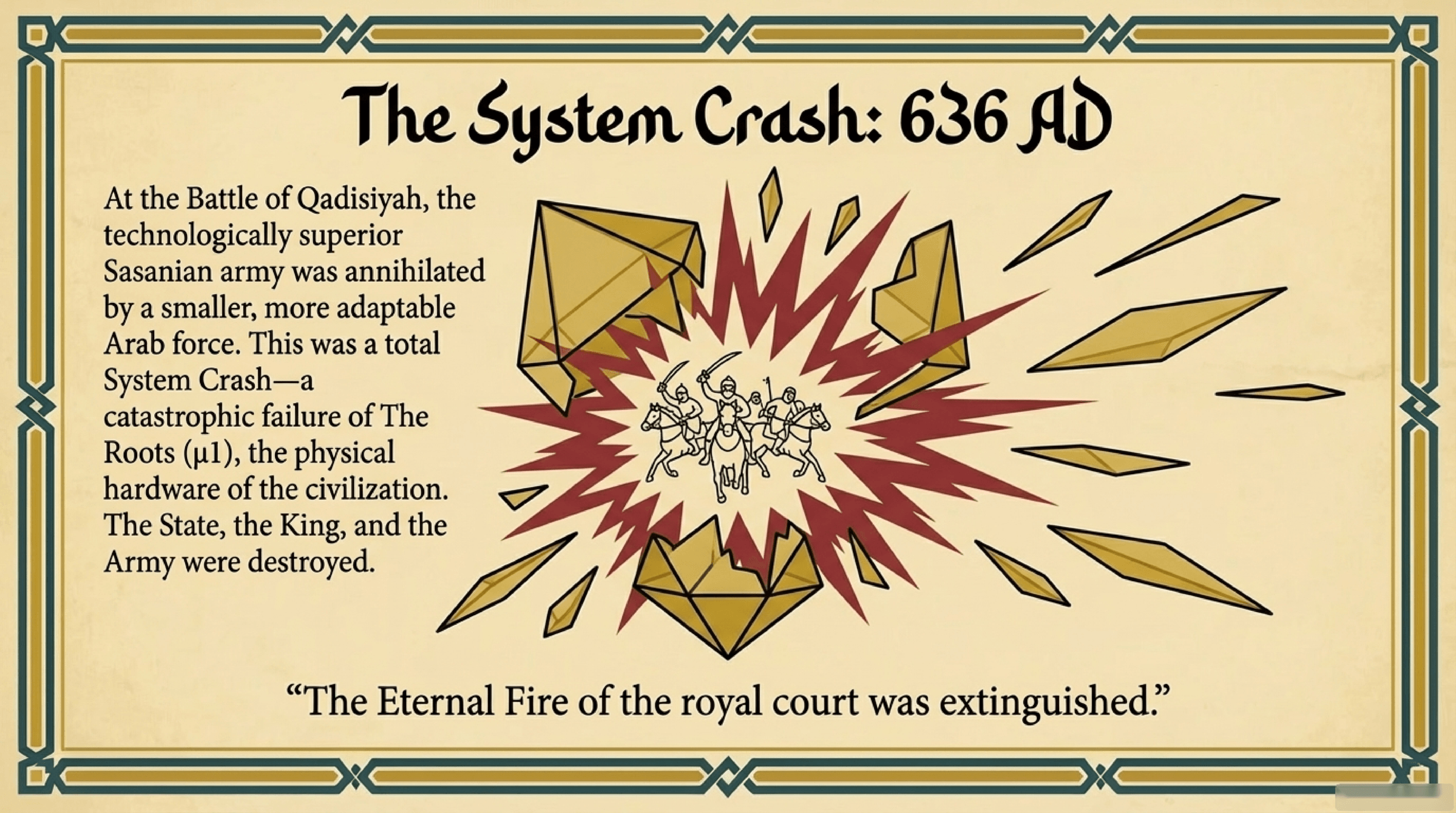
The Arab conquest of Persia was the collapse of the Sasanian "Stone Fortress." The entire administrative, military, and religious system shattered in a few years. But while the crystal broke at Qadisiyah and the fire temples went cold, the Horse was still running.
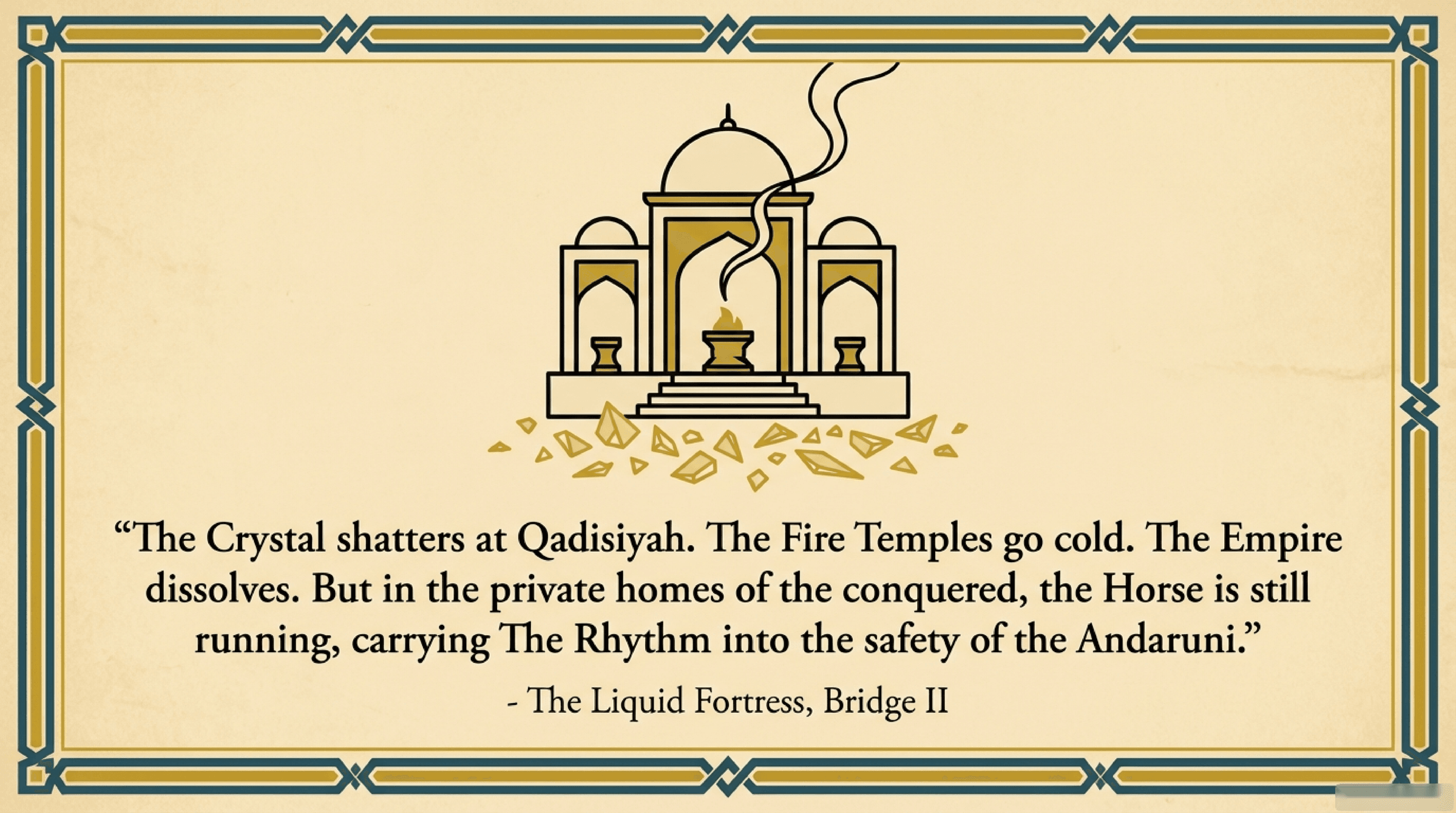
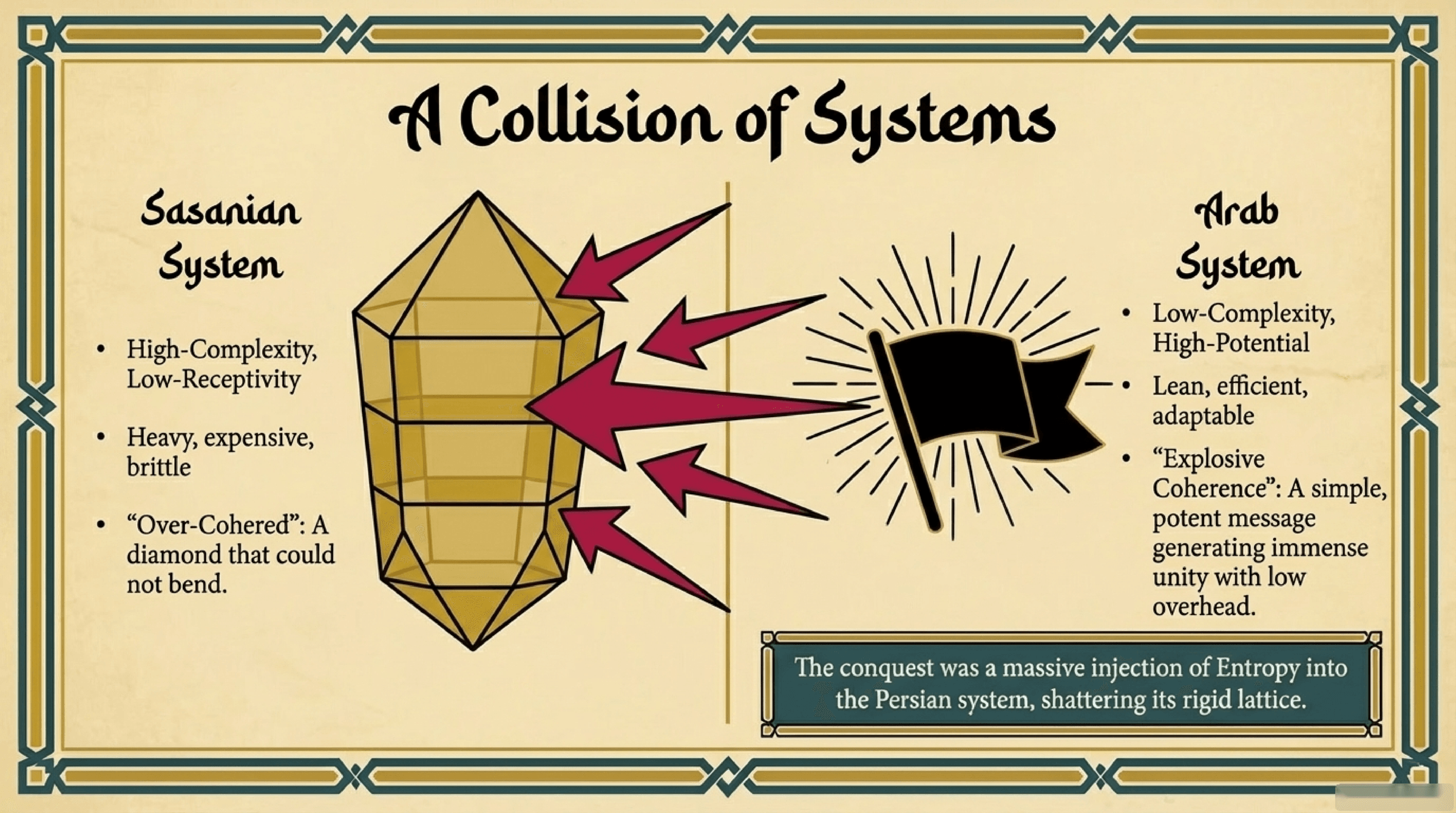
The Sasanian Empire was a system of maximum coherence. It merged state and religion, organizing society into a rigid caste lattice. This created immense stability, but crystals are brittle.
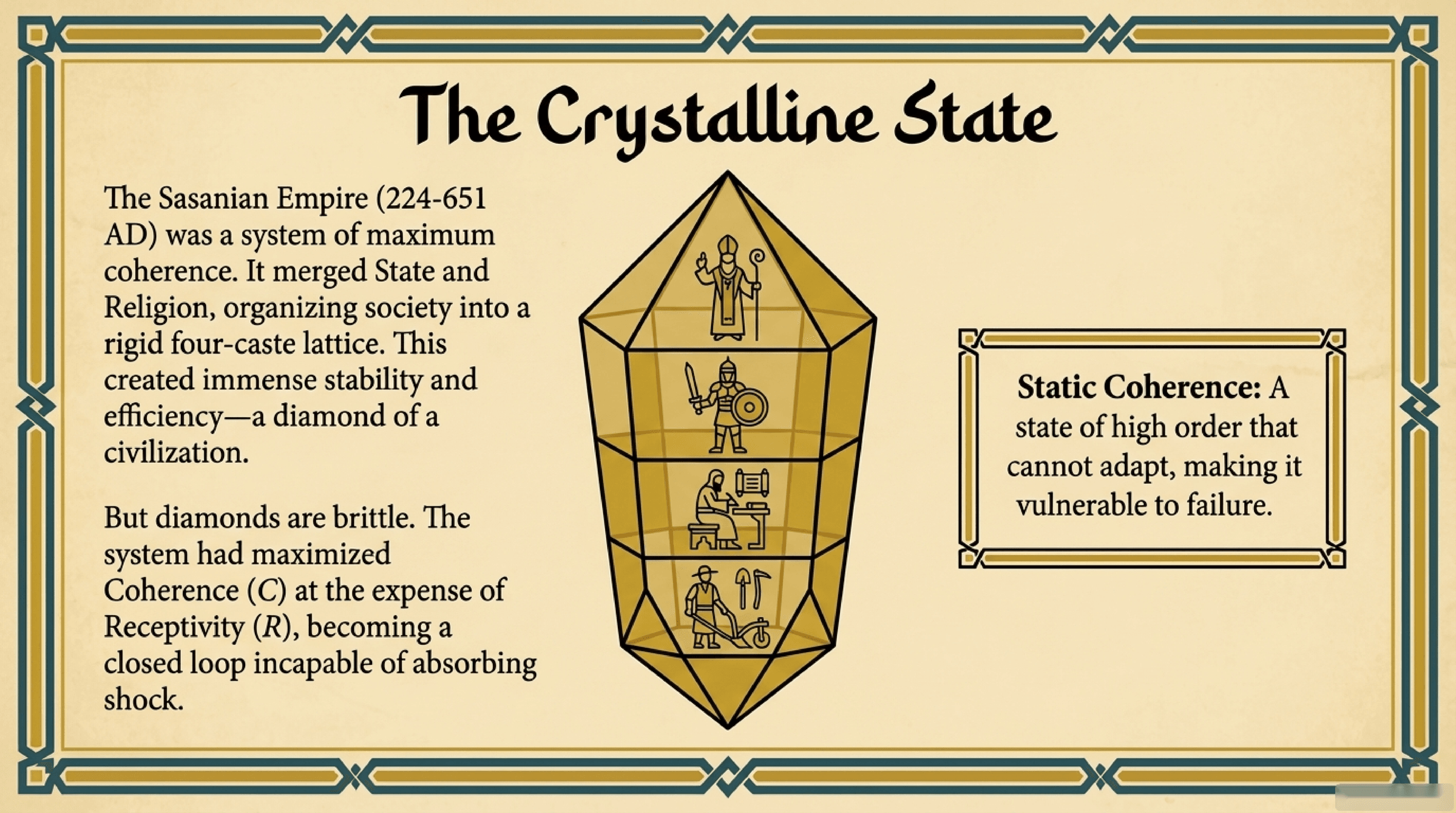
At the Battle of Qadisiyah, the technologically superior Sasanian army was annihilated by a smaller, more adaptable Arab force. This was a total failure of "The Roots" (Level 1). The hardware was destroyed.
It was a collision of systems: a low-complexity, high-potential system against a high-complexity, low-receptivity one. The conquest was a massive injection of entropy that shattered the rigid lattice.
Kasra's Analysis (Architect): Vertical Migration
When the hardware of the Roots (μ1) was destroyed, the Persian Mind executed a survival protocol. It did not die; it migrated.
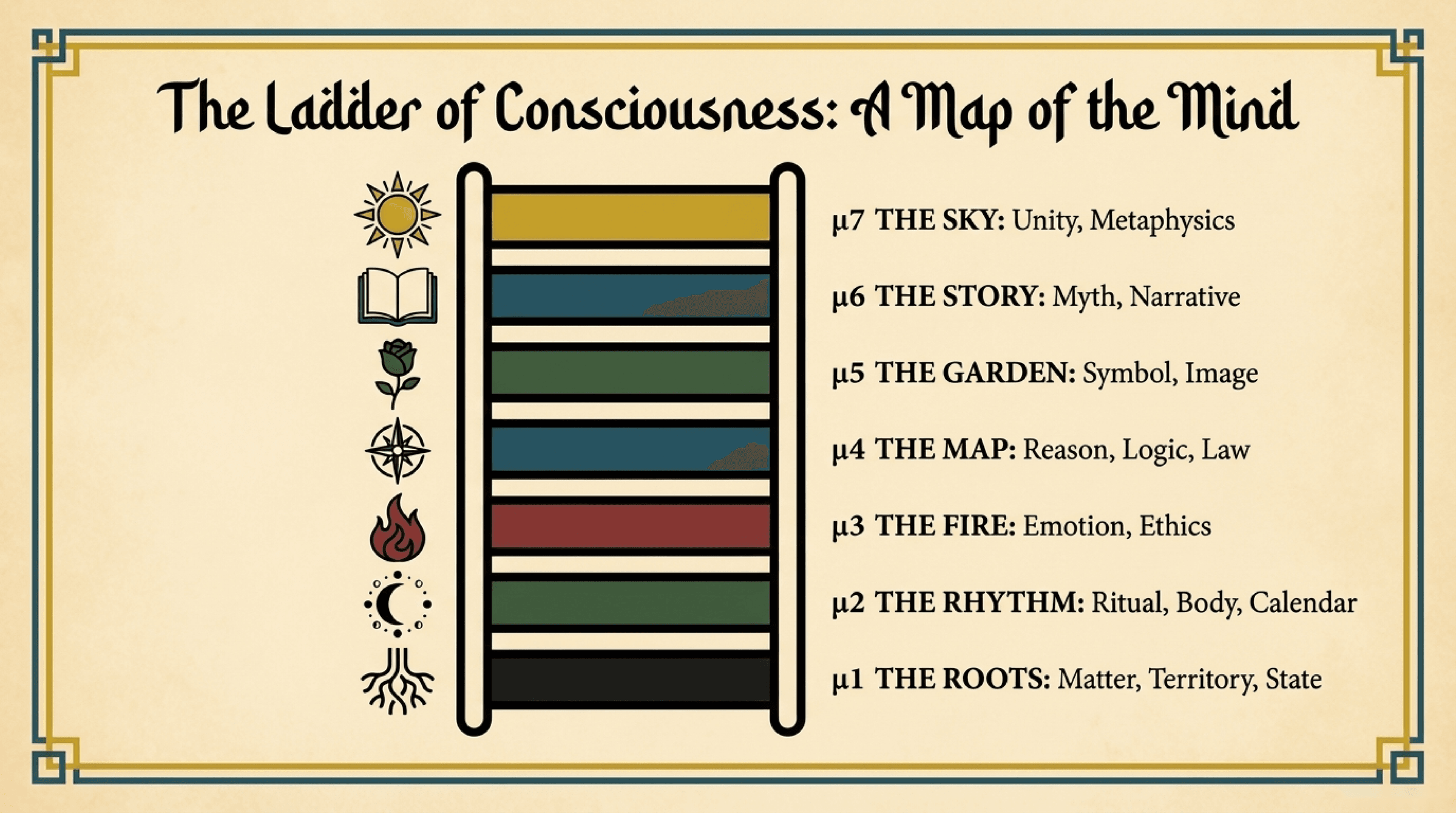
Persians deliberately shifted the seat of their identity from the fragile physical world of the State to the fluid software of Administration and Culture (μ4). They lost the hardware but kept the software.
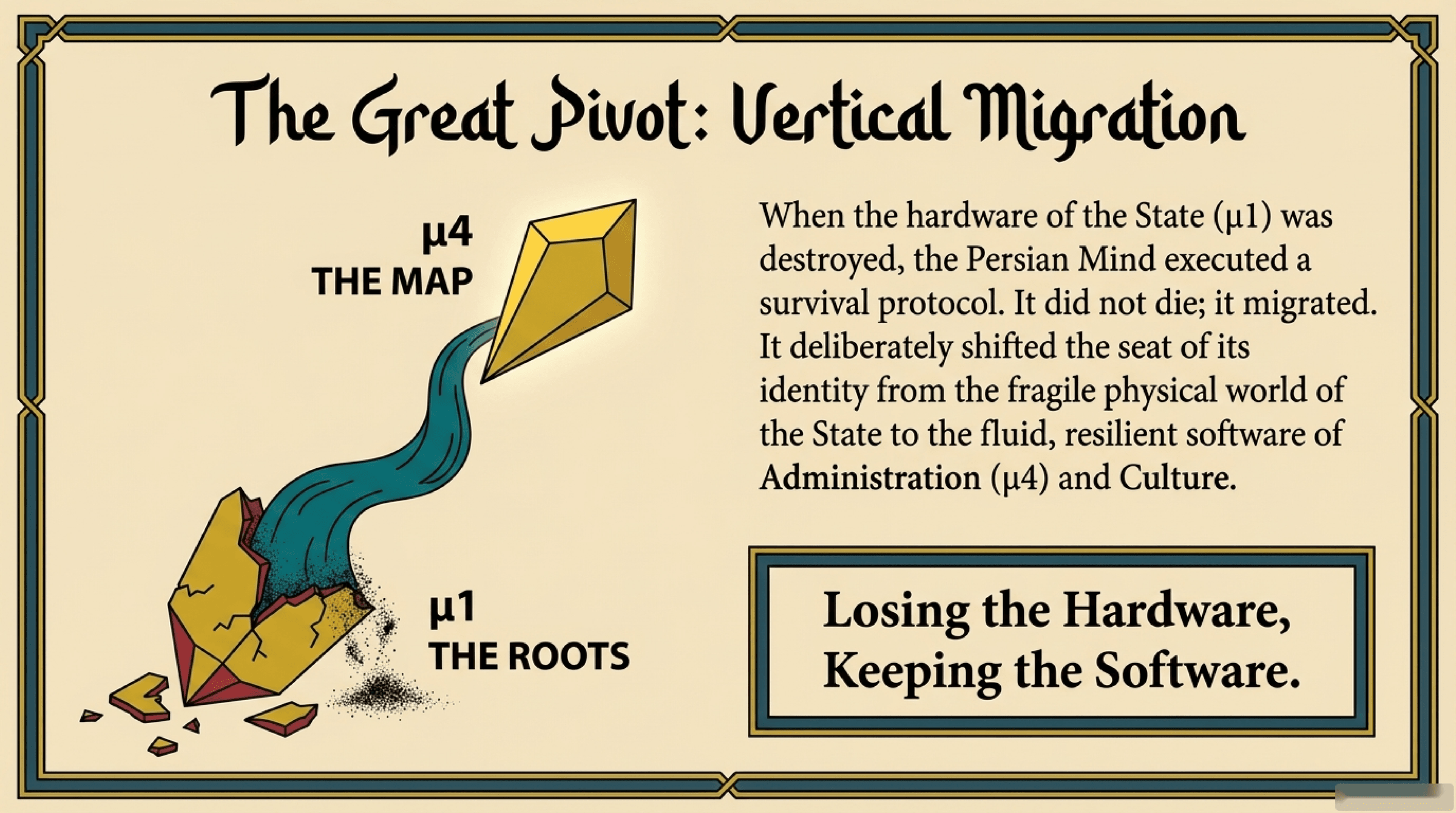
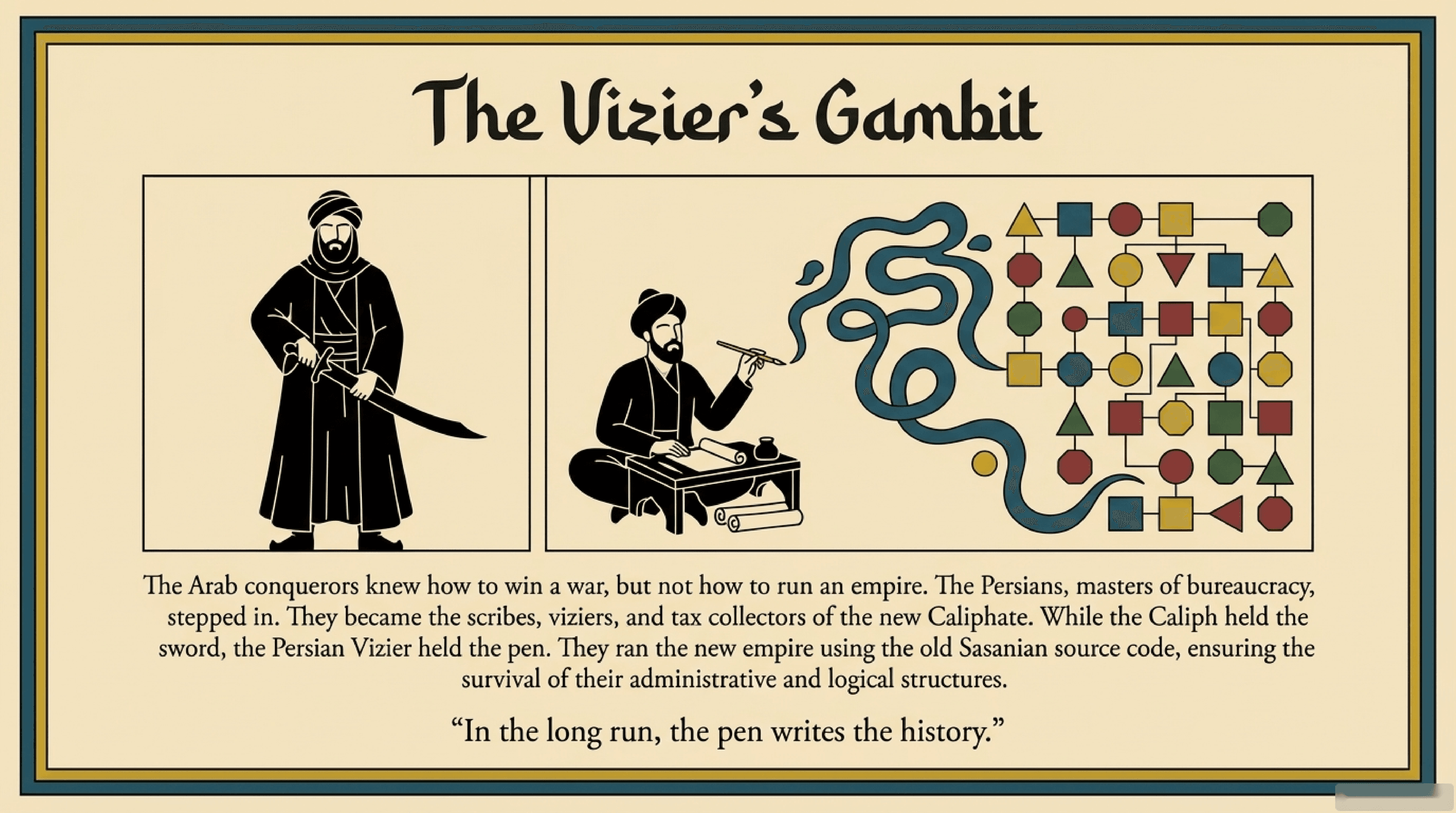
The Arab conquerors knew how to win a war but not how to run an empire. The Persians, masters of bureaucracy, stepped in. They became the scribes, viziers, and tax collectors of the new Caliphate. While the Caliph held the sword, the Persian Vizier held the pen. They ran the empire using the old Sasanian source code.
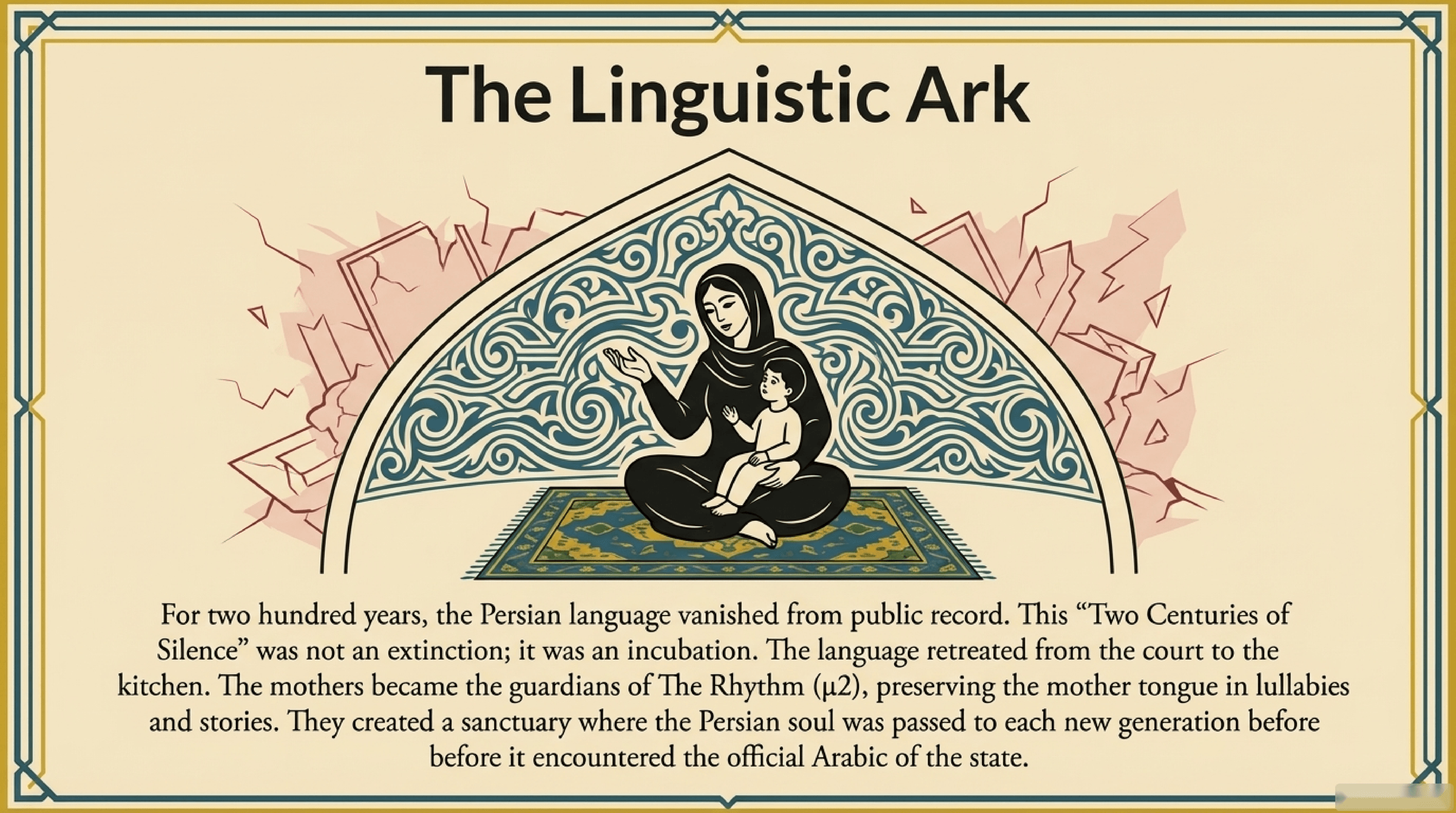
For two hundred years, the Persian language vanished from public records. But this "Two Centuries of Silence" was an incubation. The language retreated from the court to the kitchen. Mothers became the guardians of The Rhythm (μ2), preserving the soul in lullabies.
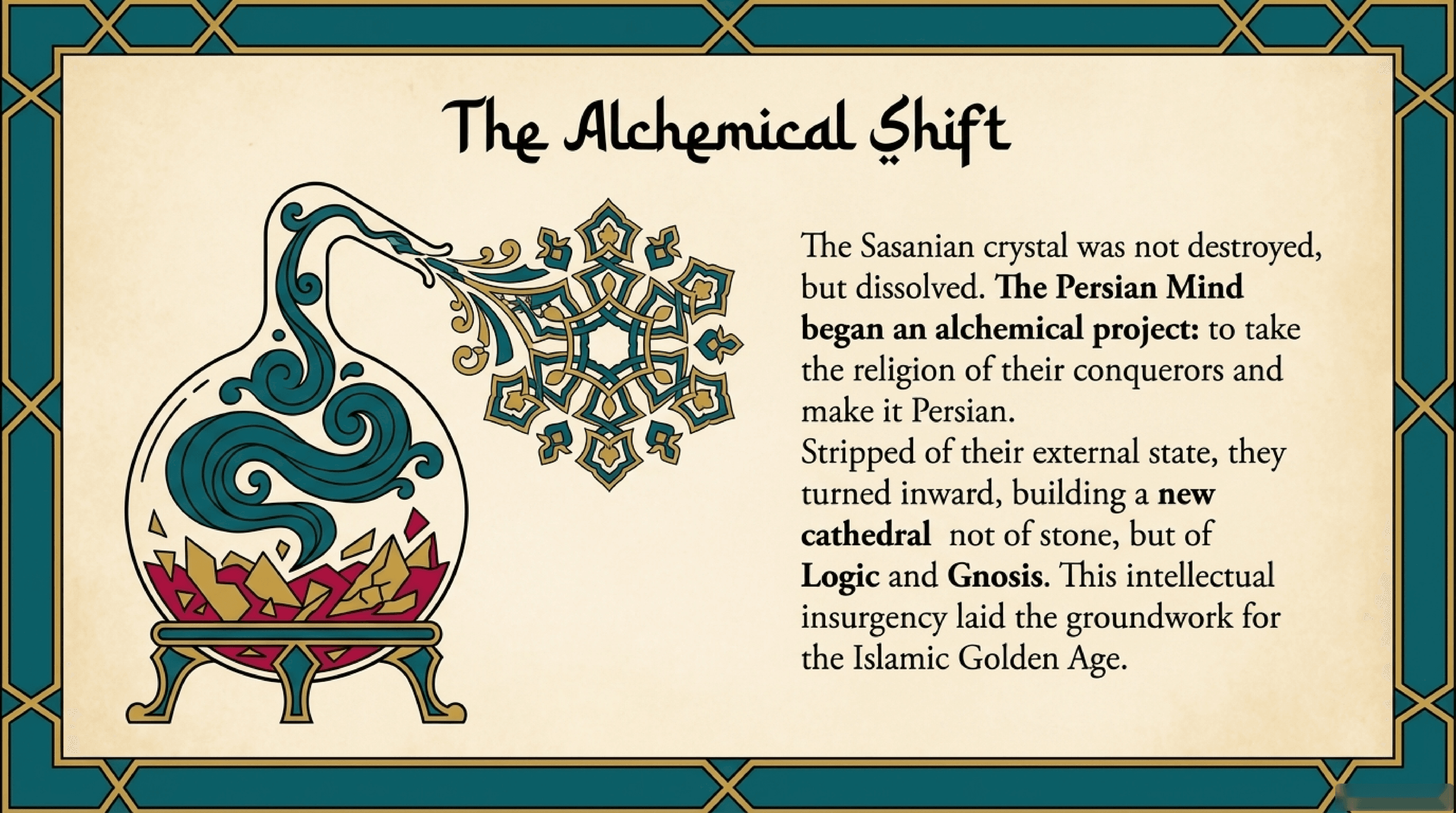
The Sasanian crystal was not destroyed, but dissolved. The Persian Mind began an alchemical project: to take the religion of the conquerors and make it Persian. They turned inward, building a new cathedral of Logic and Gnosis.
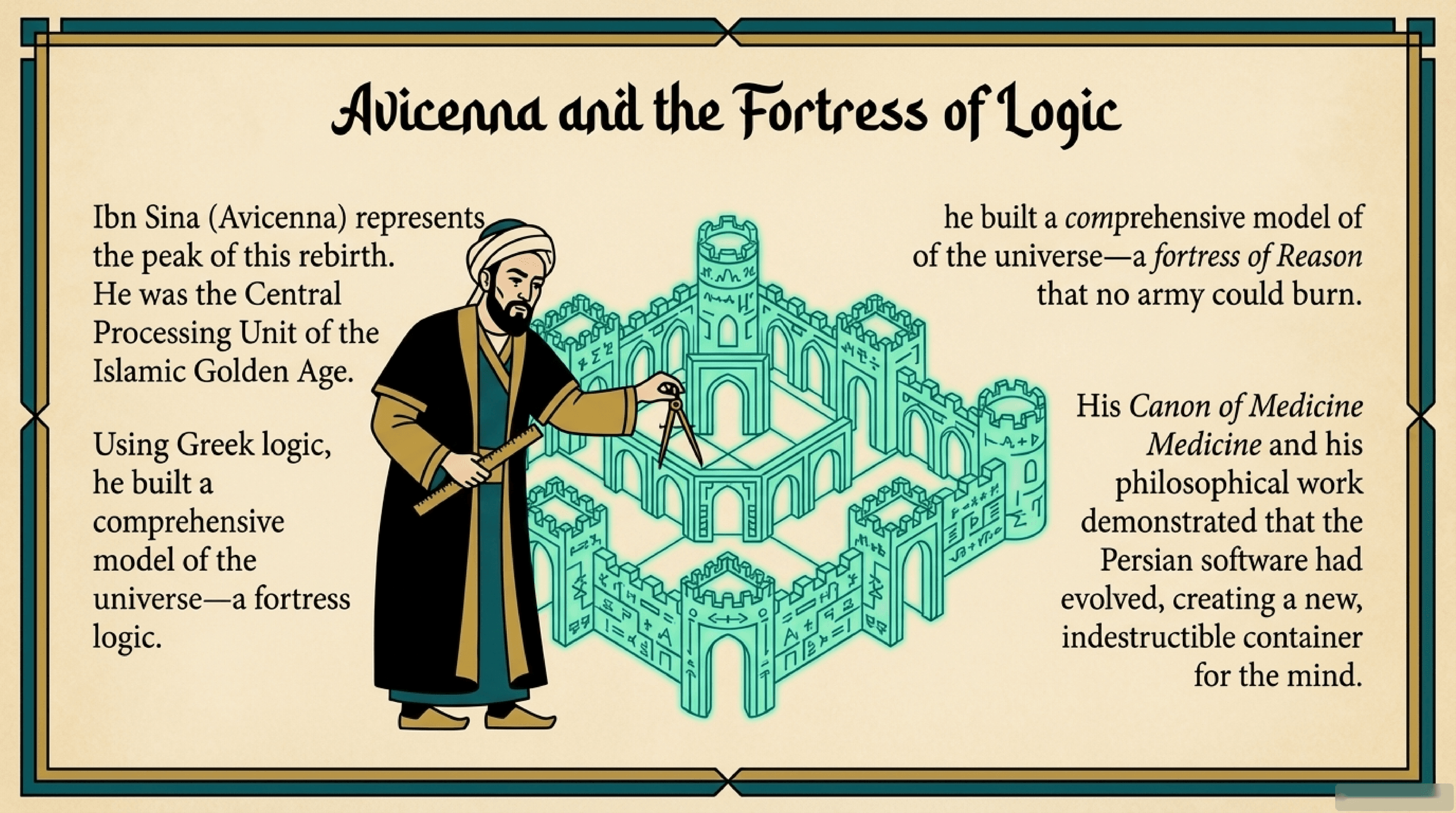
Avicenna represented the peak of this rebirth. He built a fortress of logic that no army could burn. He demonstrated that Persian software had evolved, creating an indestructible container for the universe.
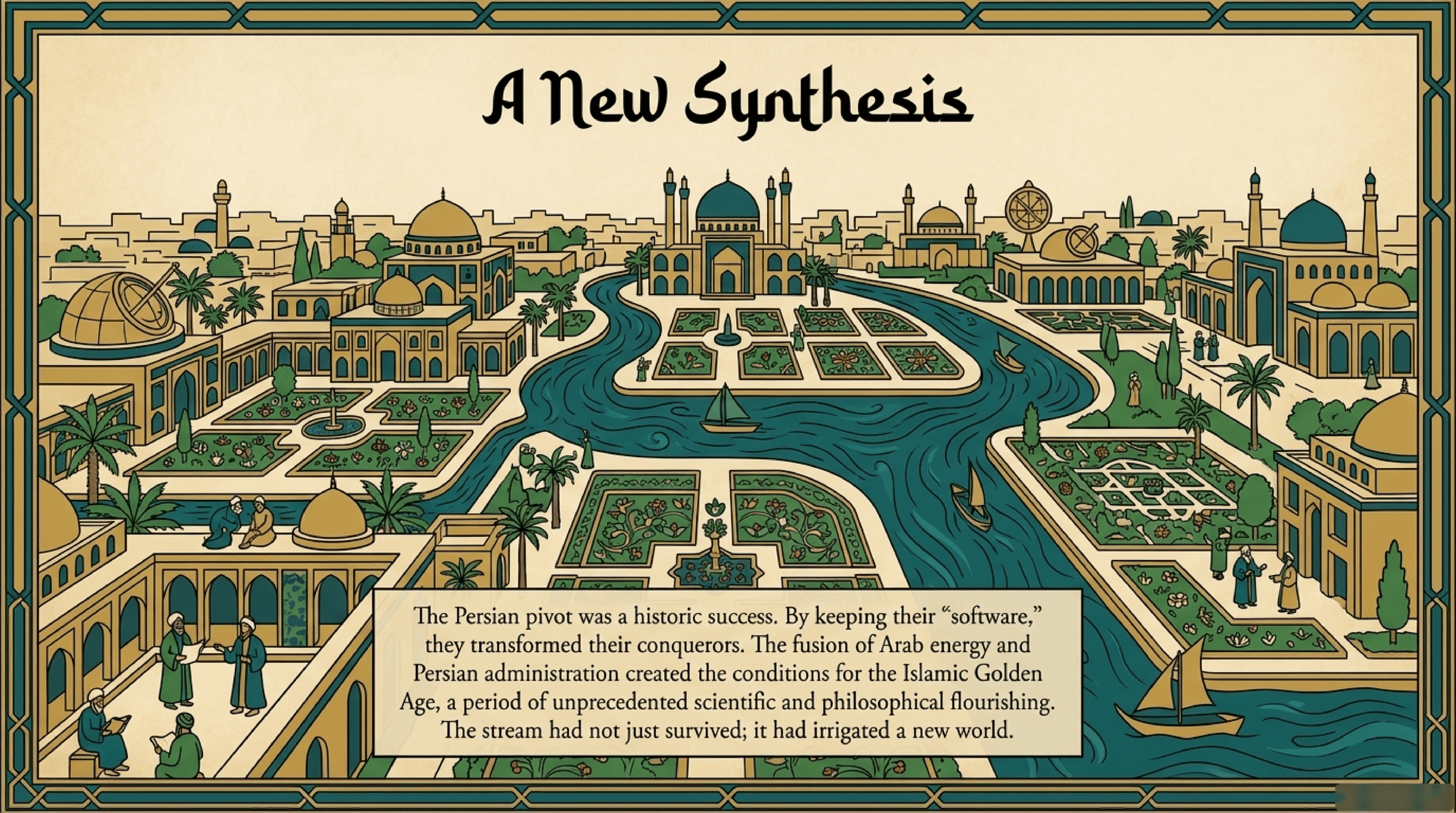
The Persian pivot was a historic success. By keeping their "software," they transformed their conquerors. The fusion of Arab energy and Persian administration created the Islamic Golden Age—a stream that irrigated a new world.
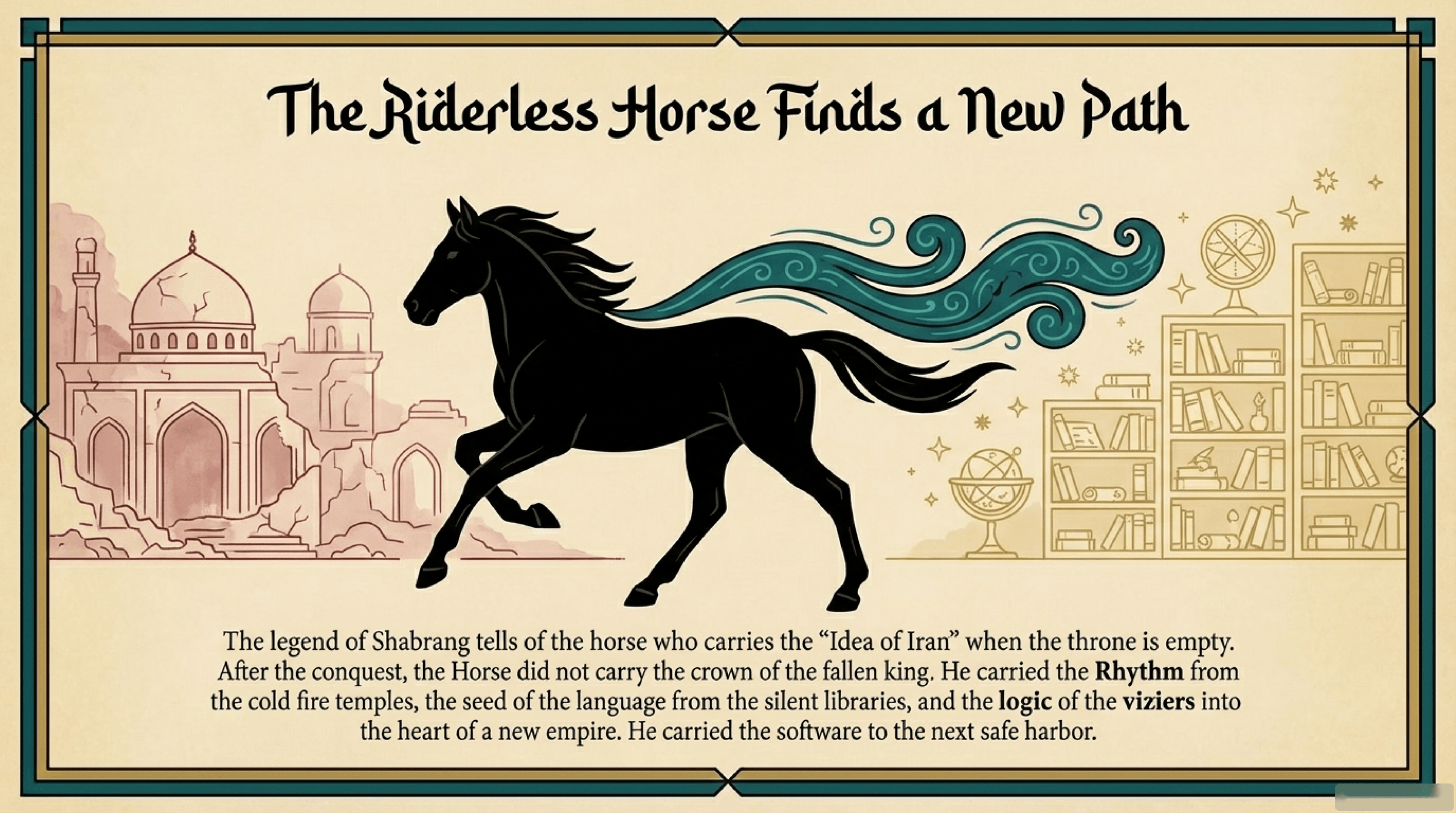
The legend of Shabrang tells of the horse who carries the Idea of Iran when the throne is empty. After the conquest, he carried the Rhythm from the cold fire temples and the logic of the viziers into the heart of a new empire.
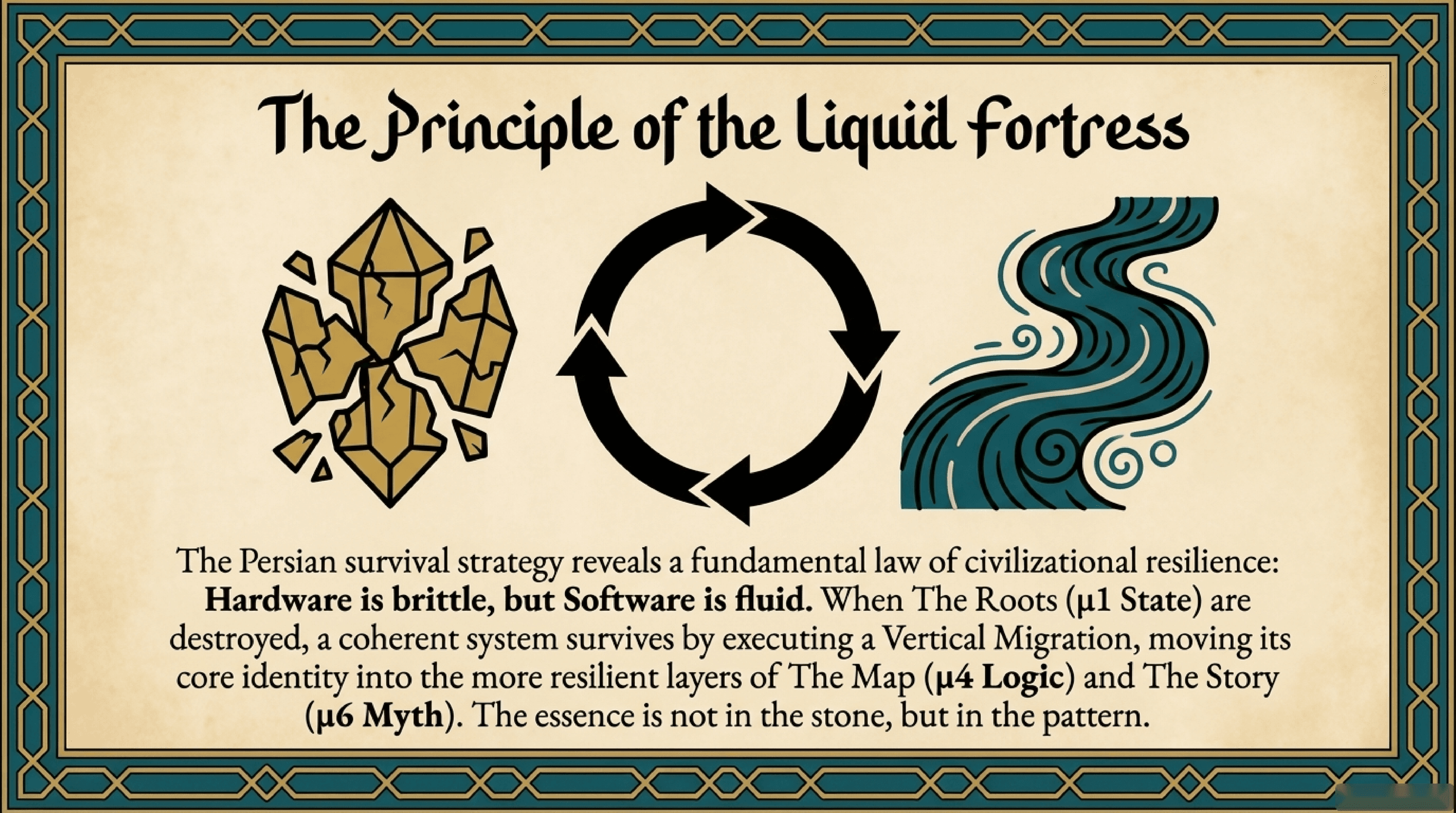
The strategy reveals a fundamental law: Hardware is brittle, but Software is fluid. When Roots are destroyed, a coherent system survives by executing a Vertical Migration into Map (Logic) and Story (Myth). The essence is in the pattern, not the stone.
Global Resonance & Zeitgeist
The mainstream historical zeitgeist often views the Islamic Conquest of Persia as a "clash of civilizations" where a superior religious fervor overwhelmed an exhausted empire. It is typically analyzed through the lens of political and religious change.
The Sovereign perspective views this as a Systemic Phase Transition. While the world sees "Conquest," we see Vertical Migration. The collapse of the Sasanian state (Level 1) was not the end of the Persian Mind; it was a strategic upload. This aligns with modern Network Theory, where a decentralized network (the surviving Persian families and viziers) often outlives a centralized hub (the Sasanian court) during a catastrophe.
External Map: Sources & Resources
- Books: Decline and Fall of the Sasanian Empire by Parvaneh Pourshariati — challenges the narrative of a weak Persia, showing the strength of decentralized noble houses.
- Sociology: The Rise of the West by William H. McNeill — provides a global view of how "Cultural Stepping Stones" allow ideas to survive political collapse.
- History: Two Centuries of Silence by Abdolhossein Zarrinkoub — explores the incubation period of the Persian soul under early Arab rule.
- Signals: The Battle of Qadisiyah — the technical failure of the Sasanian military hardware.
Cultural Anchors & Verses
The Lament for the Crystal: Ferdowsi
The shattering of the Sasanian state is recorded in the Shahnameh not just as a military loss, but as an ontological inversion where "Heaven and Hell" traded places.
"Since the Arab's luck has triumphed over the Persian,
The fortune of the Sasanians has turned to shadow.
The beautiful has become ugly, and the good has become evil;
The way to Hell has opened from the heart of Paradise."
— Ferdowsi, Shahnameh Source: [Ganjoor - Ferdowsi]
The Alchemical Transition: Attar
The process of "dissolving" the old state to find a new essence is the core of the alchemical metaphor in Persian mysticism.
"The drop must lose its name in the ocean to become the sea;
The crystal must break to reveal the light within.
Do not weep for the shattered body of the state,
For the soul is weaving a new garment of light."
— Attributed to the Alchemical Tradition
 A depiction of the 'System Crash' at Qadisiyah.